I’m
guessing you’ve never heard of Tern Island. I’m also guessing that you may not care
that this remote Pacific Ocean Island was just given money by the federal
government to clean up marine debris and lead contamination that have heavily
polluted it. Allow me to explain this after we get through the set up which is,
admittedly, a little tedious.
The
Environmental Protection Agency (EPA) and the U.S. Fish and Wildlife Service agree
there have been releases of hazardous substances like polychlorinated biphenyls
(PCB - man-made organic chemicals which
were domestically manufactured from 1929 until they were banned in 1979) and lead from when the
military buried it on the island. And? And that’s not a good thing, regardless
of this obscure stick of dirt.
Briefly
Tern
Island is located 564 miles northwest of Honolulu and comprises part of the
Hawaiian Islands National Wildlife Refuge, and Papahānaumokuākea Marine
National Monument which is in the Northwest Hawaiian Islands (NWHI), and it
lies within the Coral Reef Ecosystem Reserve managed by National Oceanic and
Atmospheric Administration (NOAA), and
the State of Hawaii’s NWHI Marine Refuge. That’s a lot of titles for a small
strip of land that looks like a large piece of bacon. But Tern Island is also
home to 7,000 recorded marine species, over 2,000 of which are endemic, existing
only in the Northwest Hawaiian Islands. The area is nesting habitat for 95% of
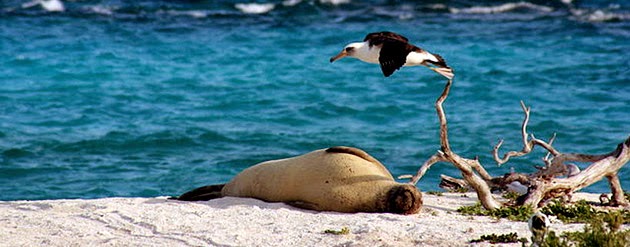
the population of the cute Hawaiian green sea turtles. It’s also pupping
habitat for 16% of the, also cute, Hawaiian monk seals, and is the nesting site
for approximately 6% of the world’s black footed albatross, you know, those less
cute birds that literally fly for years without setting foot on land. I hear
you asking again…and? And bear with me.
The Making Of Tern
Island
Tern
is part of an atoll known as French Frigate Shoals consisting of two crescent-shaped
reefs surrounding a 140-square-mile lagoon, the outer boundary of which was the
perimeter of a once active volcano. When it was first documented in 1786 the
island was a small sand shoal and undoubtedly no one really cared about this
desolate aggregate plot of dirt…at least until World War II.

The
island was artificially enlarged by the U.S. Navy in 1942 and used until 1946
as an airfield and refueling stop, since it was close to Japan, then used by
the U.S. Coast Guard until 1979. Tern was originally 1,800 feet long and 450 feet
wide, but the Navy dredged 500,000 cubic yards of coral from an adjacent lagoon
to construct a landing strip on Tern, and the end result was a new island 3,100
feet long by 350 feet wide. Construction of the island was accomplished by
creating a seawall from 5,000 feet of double-walled steel sheet piling. The
seawall around the perimeter of the island held the coral in place giving the
island an artificial structure. What once was an 11-acre natural island morphed
into a 34-acre naval facility with a landing strip, eight buildings, and 21
underground storage tanks each with a 5,000-gallon capacity for holding
aviation fuel. Ah, the fuel - stunningly it was left in the tanks after the Navy and Coast Guard left the island. That
fuel leaked into the sand and water as the tanks deteriorated, contaminating
parts of the island and effecting nearby islands and, sadly, lead and PCB’s showed
up decades later in marine animals. During the time that Tern was used by the
Navy and Coast Guard each group discarded and buried batteries, capacitors, and
transformers in the island. This was
nothing nefarious as this was standard policy at the time and a host of WW II
bases have been plagued with problems similar to Tern because there was never
any foresight into the long-term consequences of burying toxic materials
underground to begin with. (Consider Camp Lejeune in North Carolina, Air Force
Plant #4 in Forth Worth Texas; and the Fort Wingate Depot in Gallup, New Mexico
- all Superfund sites defined as “uncontrolled hazardous waste”).
 |
| Tern's sea turtles |
Okay,
so that’s an interesting tidbit of American history. But who still cares about
a fake island in the middle of the Pacific? “Tern Island is home to the
Hawaiian monk seal, the United States’ most endangered marine mammal and the
official state mammal of Hawaii,” says Jared Blumenfeld of EPA. “We must move
forward to protect the seals and all the wildlife dependent on this
extraordinary Pacific island.” Some of you might agree, and others might say
that they’ve never even seen a Hawaiian monk seal so what difference does it
make? I understand that. Tern Island and its surrounding atoll are designated
as a critical habitat for the monk seal, whose total population of just 1,200
has been steadily declining, and that’s not meant to pull at your heartstrings,
it’s just the reality. The atoll also plays a vital role as a breeding colony for
lots of bids and faces loss of land habitat in the wake of climate change and
projected sea level rise since Tern barely makes it above the water line.
Still
not a convincing argument for why this matters?
 |
| Debris left on Tern Island stranded this Monk Seal |
The Bigger Issue
The
real problem is that Tern Island is located within the North Pacific
Subtropical Convergence Zone – fancy talk for where a high concentration of
marine debris from global sources tends to accumulate. Initial studies
conducted by EPA indicated that microplastic marine debris (meaning five
millimeters or less in size – that’s 13/64 of an inch, pretty damn small) accumulates
and transports contaminants from the
marine environment and into the animal
food chain, and our food chain. According to NOAA, marine debris can and does
injure and kill marine life and poses a threat to human health. “Our oceans and
waterways are polluted with a wide variety of marine debris ranging from soda
cans and plastic bags to derelict fishing gear and abandoned vessels,” NOAA
says, and they define marine debris as “any persistent solid material that is
manufactured or processed and directly or indirectly, intentionally or
unintentionally, disposed of or abandoned into the marine environment.” Whoa,
that could be a lot of junk. And today, there is no place on Earth immune to
this problem. “A majority of the trash that covers our beaches comes from storm
drains and sewers, as well as from shoreline and recreational activities such
as picnicking and beachgoing,” NOAA says. Bluntly put, a lot of people are pigs
and never properly dispose of their trash. Discarded fishing gear is a problem
because it can entangle, injure, maim, and even drown marine wildlife, both on
shore and in the open ocean. EPA wrote an assessment of Tern and suggested “data
collected from Tern Island show a clear progression of bio-concentration and
bio-magnification of PCBs in the local marine life.” Even areas outside the NWHI are now contaminated. “Microplastics,
coupled with other known and suspected PCB sources on Tern Island, present a
possible, and an as yet uninvestigated, exposure pathway of contaminants into
the marine food web,” Blumenfeld wrote.
Why Care?
This
is why should you care about contamination of the food chain and water near
Hawaii. But is that really a concern to most Americans? I posed that question
to the EPA office in Hawaii. The response from the government? “Plastic
pollution in the ocean is a threat not only to the marine ecosystem, but
possibly to human health as well. The fish that ingest the microplastic
and the associated pollutants will potentially end up on our dinner
table. EPA and many other organizations and researchers are assessing the
extent to which such pollutants might accumulate in the human body through
ingestion of fish.” The problem with this response is predictable - no one
still cares about Tern Island. How can anyone on the U.S. mainland think they
might “potentially” eat fish contaminated with plastics or lead from a place
thousands of miles away in the middle of the massive Pacific Ocean? And that is
the crux of the issue. Unfortunately, though not surprisingly, EPA could only
provide a typically tedious, disconnected governmental response. Don’t misunderstand;
I fully believe that our environment needs to be treated with the utmost
respect. But how to convince someone in Iowa, Mississippi, or North Dakota for
example, that Tern Island matters to them in a tangible, practical way? I guess
I’m on my own to do this.
Here
goes: Water migrates where it will and you cannot stop it. As proof of this the
collection of marine debris on Tern shows how currents move debris across large
swaths of open ocean. Is it possible then that fish, birds and other animals
contaminated with lead and PCBs from Tern might migrate over vast distances and
find their way into a food chain closer to home? Unequivocally, yes. There is
not any place on this globe of ours that does not suffer from any kind of
pollution. Currents move, winds blow, water spreads and lead from Tern has
clearly migrated to nearby islands. The source of pollution and contamination
throughout our world is a collective contamination of epic proportions because
it does not stay in one place. As of September 2014, the first case of the Ebola
virus in the U.S was reported by the CDC and that virus migrated in the body of
Thomas Duncan from Liberia to Texas, almost 5,800 miles away, actually less
than the 4,700 miles from the U.S. to Tern Island.
 |
| Marine debris from the Japan tsunami |
It
is the idea that virus, pollution, toxicity can migrate rapidly throughout our
world that I want you to understand. We no longer live in isolation. Substantial
pollution from Beijing affects other countries. A volcano in Iceland erupts and
disrupts air traffic in Spain (I was stuck in Madrid when this occurred).
Fukishima radiation flows into the sea in Japan and migrates half a world a way
to the California shore. People dump their old medicines in their toilets and
it finds its way into our drinking water. An animal feeding operation in
Georgia discharges liquid animal manure into Lake Blackshear, a body of water
Georgians use for water recreation, which then had unhealthy levels of
bacteria.
This
is why Tern Island is important. None of us are too far from toxic contamination;
we are not immune, even if we deny its very existence. I do not say this to
induce fear. Fear does not interest me. Intelligent response to the problems we
collectively face is what interests me. Therefore we should care, actively care,
about pollution in other parts of the world and the health of our waters. It
will be expensive and time consuming to clean up. This is our only planet, our
one and only home, and she urgently needs our attention.


