Showing posts with label EPA. Show all posts

Saturday, August 25, 2018

Book Review: "What the Eyes Don’t See" – Lead, Water and Michigan Politics


Flint. In that singular word is summed up a water crisis. Even if you don’t know much about what happened, the word Flint is now associated with water, and not in a good way.

Flint, Michigan is where this book takes place. The city of Flint always relied on public drinking water from Lake Huron. But that water was more expensive and Flint’s economic woes caused a chain reaction that caused the city to switch to another public water source; a chain reaction that many public officials still have not been held accountable for. April 25 2014 was the date the water supply changed from Lake Huron to the Flint River, a switch precipitated by the basest of all things…money. It was cheaper to use degraded water. But the public noticed immediately. The water looked bad and tasted worse. More chlorine was added; boil alerts were sent out. It was suggested by the city that residents should “flush” their water for at least five minutes before using it. As author Mona Hanna-Attisha points out, it was discovered there were lead contamination issues with Flint city water. But the book also addresses the larger issue of lead that it is a subject rooted in the historical context of the seen physical environment. The author states: “When the League of Nations banned lead paint in 1922 the U.S. declined to go along,” she writes. “At that point the regulation of lead paint in this country was almost nonexistent. Lead was big business in America.” And everyone thought of lead as a physical property that was tangible - paint. In fact lead was finally restricted, but not totally outlawed, in plumbing – those pipes in our home bringing us clean water - only in 1986.

She continues on: “Despite the well documented history and science of lead in water, the issue remained under ground and out of sight. And yet unlike any other form of lead exposure, lead in water impacts a much younger and much more developmentally vulnerable age group. Even more insidious than lead in paint, lead in water, colorless odorless and invisible, is meant for ingesting.” She chronicles how she began testing for lead in her patients, how a small force who knew there was lead in the water combated a larger bungling city and state government to prove there was lead contamination and how they fought, along with the help of local media, to expose failings from the City of Flint, the county, the state and the EPA. As she puts it bluntly on page 13, “This is the story of the most important and emblematic environmental and public health disaster of this young century. It is the story of a government poisoning its own citizens and then lying about it. It is a story about what happens when the very people responsible for keeping us safe care more about money and power than they care about us.”

Author Dr. Mona Hanna-Attisha
Once the lead issue was exposed to the media and to the whole of the American public, the bottled water community stepped in providing innumerable cases of clean, fresh water for residents. Beginning in 2016 the state had been providing free bottled water for residents, but that came to an abrupt halt in April 2018. As the New York Times reported, the City of Flint is currently working with contractors to replace all of the affected lead compromised plumbing lines by 2020. “Just over 6,200 have been replaced so far,” said Steve Branch, the acting city administrator. “An estimated 12,000 could remain.” This mean that there is still compromised plumbing. But perhaps one of the most disturbing things about the water crisis is found on page 284. “We found out later that in January 2015 state officials, while telling Flint residents that their water was safe to drink, were arranging for water coolers to be delivered to the Flint State office building so state employees wouldn't have to drink from the tap.” This revelation shows the staggering callousness of local officials. Fortunately, due to her commitment, the author was able to unravel the lead contamination and bring the issue to light.

While the book is an interesting read in terms of how the water crisis unfolded, it also is a message of troubling proportion in terms of local, county, state and federal officials and their willful deception in ignoring the lead crisis. What the Eyes Don’t See serves as a reminder that we must continually fight for clean water, an issue that desperately needs to be addressed not only in Flint Michigan, but also across the US and across the globe where water is being compromised on a daily basis, sometimes out of ignorance, but almost always because of money. And do not be fooled. This could happen where you live too.


By Mona Hanna-Attisha
One World Publishing
364 pages/$24.95 Hardback


Tuesday, January 19, 2016

Flint’s Water: The Tip of the Toxic Iceberg?


The current issue revolving the water contamination in Flint, Michigan reveals the sad and harsh truth that in some cases, our government authorities mismanage our water supplies and the outcome can have fatal consequences. That city officials in Flint, under the guise of a cost-cutting, money-saving myopic plan, changed their water supply to use a known contaminated body of water is beyond irresponsible. It is criminal. Regulations to treat the water were ignored and city officials should be prosecuted for their actions. It is unreasonable in this day and age and in this country to have such a serious problem in a city the size of Flint (population about 100,000 -  meaning this is not some rural backward city). But if you’re thinking Flint’s water woes is an anomaly, I present to you, and fully detail in my book, Our World of Water, two other examples of known and willful contamination of water by humans. There are many more, but let’s look at one in England, and one in Italy.

ENGLAND
Camelford, England has its origins around 1259 and local folklore suggests that Camelford was once Camelot of King Arthur legend, but that has never been actually proved, it is conjecture. What is not conjecture is that in 1988 contamination of the drinking water supply saw 20 tons of aluminum sulfate in the water raising the concentration to 3,000 times the allowable limit. As the aluminum sulphate broke down it produced tons of sulfuric acid which stripped chemicals from pipes as well as lead and copper piping in people’s homes. People who came into contact with the contaminated water experienced a range of short-term health effects such as joint pain, diarrhea, blistering of the skin, and hair turning shades of green from copper residue in the water. Many victims suffered long-term effects. The early deaths of many Camelford residents are believed to be associated with the contaminated water, but there has been no rigorous monitoring of the health of the victims since the incident, considered Britain's worst mass poisoning event affecting about 20,000 people. Inquests on people who died many years later found very high levels of aluminum in their brain.

Immediately after the contamination authorities said the water was safe to drink, (exactly like the Elk River contamination in West Virginia in early 2014) and it was advised to use juice to cover any unpleasant taste – a ridiculous comment at best. In an inquest in 2012 into the death of one of the victims, the coroner stated that the South West Water Authority had been “gambling with as many as 20,000 lives” when they failed to inform the public about the poisoning for 16 days. There were allegations of a cover-up and West Somerset Coroner Michael Rose stated: “I found there was a deliberate policy to not advise the public of the true nature until some 16 days after the occurrence of the incident.” Following an investigation by the government's Committee on Toxicity of Chemicals in Food, Consumer Products and the Environment, the former Environment Minister claimed that “various associated bodies tried to bury the inquiry from the start. This has become a tug of war between the truth and an attempt to silence the truth.” In 2014 a final government report was issued which stated there was no link between the 20 suspected deaths and the water poisoning. The town is still divided on that since the coroner’s report reached vastly different conclusions than the official government report.

In the U.S, as well as the UK, the name of the game is sadly and dubiously called “Risk Assessment,” a process of estimating the threat that environmental contaminants pose to humans. Scientists generally base risk assessments on toxicity studies performed on laboratory animals and on data from human exposure in the workplace where a chemical is made or used. These studies estimate potential health threats to people exposed over many years to low levels of chemicals in drinking water, but these types of studies also produce ambiguous results. Uncertainties stem from incomplete data and the difficulty of comparing health effects on laboratory animals to real humans living in a real environment. The risk assessment for a chemical usually does not take into account all chemicals people are exposed to in water, food and air. For example, the Environmental Protection Agency (EPA) has assessed the risk of a number of pesticides and volatile organic chemicals (VOC) sometimes found in drinking water. Tetrachloroethylene, a common VOC is used in dry cleaning solvents, metal degreasers, textile dyes, aerosols, and household pesticides. Experts suspect it can cause cancer and liver and kidney damage in humans. The EPA estimates that one part per billion tetrachloroethylene in drinking water could lead to one or two additional cases of cancer in a population of one million people who drink such water over a 70-year time frame. In other words, certain death, but at such low levels, it not considered harmful to the greater population. But knowing that toxic water will eventually cause certain death is clearly not enough of a motivator. But in Italy, it was worse.

ITALY
In the shadow of Mt. Vesuvius just outside of Naples is the village of Acerra. The national average for juvenile brain tumors in Italy is just 0.5 for every 100,000 children. But for Acerra’s 55,000 residents, the average number is three children with brain cancer at any given time, which has been attributed to the willful dumping of toxic chemicals into the ground and water by the Camorra crime syndicate. Over the last 20 years thousands of tons of toxic waste have been dumped, burned and buried in an area known as the ‘triangle of death’ that runs from Naples to Caserta to Mt. Vesuvius. The toxins have so polluted the groundwater and poisoned the soil the Italian government refers to the area as the “terra di tumori” - land of tumors. But in another tale of government irresponsibility, have they done anything?

According to a study by the Pascale Institute in Naples, the mortality rate from cancer in this triangle of death has risen between 15 and 20% over the last decade. But in some towns, like Acerra, the increase is more than 30%. If nothing is done to clean the soil and decontaminate the water supply the rate is expected to grow to 47% for men and 40% for women by this year, 2016. The Pascale study found that 9,969 people have died from cancer and pulmonary diseases, allegedly related to the toxic waste and water, since 2005. The British journal The Lancet, first analyzed the rising levels of toxins after the U.S. military base in Naples started warning troops and their families stationed in the area not to drink the water or eat dairy products because of suspected high levels of toxins. Then the U.S. Navy did its own study in 2011 and found that high levels of arsenic, fecal coliform, banned insecticides, and dioxins were found in random tests of water samples in the area. The report warned U.S. military personnel based in Naples to stay clear of the local water supplies, suggesting the “use of bottled water for off-base personnel, for drinking, food preparation, cooking, brushing teeth, making ice, and for pets, due to the widespread presence of contaminants as measured in the tap water, as well as the other drinking water system infrastructure deficiencies.”

The Italian government has been reluctant to admit they have known about the problem for years in spite of court transcripts in 1997 by a former Camorra underling named Carmine Schiavone, who detailed first-hand the Camorra’s actions. “It became a real business, which brought money in, but the residents risked dying of cancer within 20 years. I don’t think they can be saved,” he told the court. “We have killed your children.” Schiavone says he went to the police because he could no longer stand by and watch the illegal activity. “I warned them that this toxic waste would kill entire generations. They told me not to worry, and just drink bottled water.” It is estimated that more than 100,000 tons of toxic waste have been dumped in the area between 1991 and 2013, even implying the use of 400,000 semi trucks that ferried the waste from more 443 Italian companies who reportedly commissioned the Camorra to do their dirty work (literally) rather than disposing of the waste properly. If there is indeed government collusion on this, it unmasks the vulnerability of the municipal water supply.

Can your tap water kill you? The unfortunate answer is yes – though to be clear these are uncommon occurrences and my objective is never to produce fear, but to produce change. The above examples show that contaminated tap water can kill sometimes quickly, and sometimes over a period of decades and this is the exact reason we need to be vigilant about our water supplies and uncover governmental mismanagement, like what is happening in Flint right now, fix the problem and prosecute those who clearly do wrong to our water.

Sunday, June 28, 2015

What the Frack? Hydraulic Fracturing Creates Deep Fissures

(THE FOLLOWING IS EXCERPTED FROM MY BOOK, "OUR WORLD OF WATER")

Fracking is a current buzzword tossed around, but few people actually understand the basics of what it is or how it impacts drinking water around the globe. Fracking involves injecting water, sand and chemicals, including small amounts of diesel, carcinogenic benzene, even formaldehyde (depending on the specific solution used by the various companies – they all have their own specific recipe), deep into the ground to fracture (split apart) rock thereby releasing natural gas and oil trapped tightly within that rock. Fracking is not a drilling operation, but happens only after a well has been drilled. Therefore improperly drilled wells and/or faulty pipe casings can leak exposing drinking water supplies to a dangerous cocktail of chemicals.


Fracking has been definitively linked to contaminants in drinking water. As reported by investigative news site ProPublica the U.S. Environmental Protection Agency (EPA) released a draft report revealing that water contamination discovered in Pavilion, Wyoming, is caused by fracking. EPA tested two specific wells and those tests showed conclusively that there were contaminants in the water. In Wyoming 10 individual compounds related to fracking were found in residents’ drinking water, including benzene, methane, and glycol ethers, and notably the benzene was above legally allowed concentrations. The investigative journalism website ProPublica writes: “The agency’s (EPA) findings could be a turning point in the heated national debate about whether contamination from fracking is happening, and are likely to shape how the country regulates and develops natural gas resources in the Marcellus Shale (a massive compound of rock which lies under 60% of Pennsylvania’s land mass at depths of about 9,000 feet) and across the Eastern Appalachian states.” Currently there are currently about 5,000 drilled wells in the Marcellus Shale and another 2,000 are planned. Canada-based Encana Corporation, responsible for the Wyoming wells, has said the data remains inconclusive. Despite the company’s denials, The Wall Street Journal reported that Encana “has been providing fresh water to 21 homes in the area since August 2010, when it began meeting with the EPA and state regulators to find a long-term alternative to well water for the area.”


The EPA study followed complaints from residents of Pavilion, Wyoming (population according to the 2010 U.S. census was just under 200 people so it’s small and off the radar), who voiced concerns about the way their drinking water smelled and tasted. Wyoming fracking wells are a mere 1,200 feet deep, compared to rocks being fracked in Pennsylvania and other spots along the Marcellus Shale, which are thousands of feet deeper than these water wells. Amy Mall, senior policy analyst for the Natural Resources Defense Council says: “Much stronger rules are needed to ensure that well construction standards are stronger and reduce threats to drinking water.” And to a degree this is true. Environmental laws tend to be amazingly weak, but the second part of that equation is one of enforcement. Pollution rules are violated constantly, but the law is rarely enforced.

 
Common Chemicals Used in Fracking
There are literally hundreds of different “recipes”
for fracking solutions and every company uses
different amounts of whatever chemical they feel
does the job best. Here then are a few of the more
common chemicals in fracking solutions.

Ethylene Glycol (antifreeze)
Methanol
Acetaldehyde
Ammonium persulfate
Petroleum Distillate (turpentine)
Tetramethylammonium chloride


At any rate, the EPA plans to issue guidelines for states such as North Dakota, and others, to issue permits for use of hydraulic fracturing specifically involving diesel. The EPA has authority under the federal Safe Drinking Water Act to make sure hydraulic fracturing operations do not pollute drinking waters when diesel fuels are used in the processes. “The guidance document is not intended to be a regulatory document and would not itself require any state to change its regulations,” says Jim Martin, EPA’s regional administrator based in Denver. “In fact, it is based on existing best practices in use by the industry today.” But if that were the case, issues of water contamination would not keep surfacing across the country as they are in small but increasing pockets. The four-decade-old Clean Water Act of 1972 is frankly a useless document with no teeth, merely suggestions and “guidance.” 

But also understand that fracking is a global problem. The United Kingdom is wrestling with the same issues of fracking and the possible economic boon it can provide, certainly in light of their dwindling fossil fuels, in spite of Scotland’s vast oil deposits. And China too is now looking into fracking as a way to stabilize their own economic base, provide jobs and energy independence. The issue will not go away anytime soon. But is begs the larger question: when will we cease dependence on dwindling and limited fossil fuels and commit to a source of clean, renewable energy? When will we source our energy in such a way that it will not pose a threat to our world of water? I truly fear we are a long way off. 

Friday, October 10, 2014

Tern Island: How to Care About Something No One Cares About


I’m guessing you’ve never heard of Tern Island. I’m also guessing that you may not care that this remote Pacific Ocean Island was just given money by the federal government to clean up marine debris and lead contamination that have heavily polluted it. Allow me to explain this after we get through the set up which is, admittedly, a little tedious.

The Environmental Protection Agency (EPA) and the U.S. Fish and Wildlife Service agree there have been releases of hazardous substances like polychlorinated biphenyls (PCB - man-made organic chemicals which were domestically manufactured from 1929 until they were banned in 1979) and lead from when the military buried it on the island. And? And that’s not a good thing, regardless of this obscure stick of dirt.

Briefly
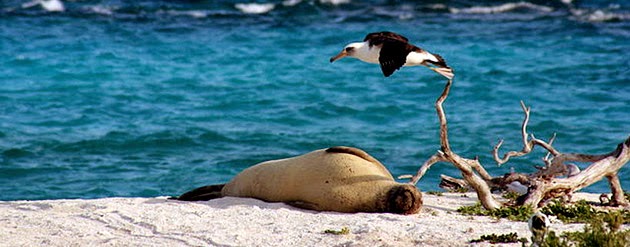
Tern Island is located 564 miles northwest of Honolulu and comprises part of the Hawaiian Islands National Wildlife Refuge, and Papahānaumokuākea Marine National Monument which is in the Northwest Hawaiian Islands (NWHI), and it lies within the Coral Reef Ecosystem Reserve managed by National Oceanic and Atmospheric Administration (NOAA), and the State of Hawaii’s NWHI Marine Refuge. That’s a lot of titles for a small strip of land that looks like a large piece of bacon. But Tern Island is also home to 7,000 recorded marine species, over 2,000 of which are endemic, existing only in the Northwest Hawaiian Islands. The area is nesting habitat for 95% of the population of the cute Hawaiian green sea turtles. It’s also pupping habitat for 16% of the, also cute, Hawaiian monk seals, and is the nesting site for approximately 6% of the world’s black footed albatross, you know, those less cute birds that literally fly for years without setting foot on land. I hear you asking again…and? And bear with me.

The Making Of Tern Island
Tern is part of an atoll known as French Frigate Shoals consisting of two crescent-shaped reefs surrounding a 140-square-mile lagoon, the outer boundary of which was the perimeter of a once active volcano. When it was first documented in 1786 the island was a small sand shoal and undoubtedly no one really cared about this desolate aggregate plot of dirt…at least until World War II.

The island was artificially enlarged by the U.S. Navy in 1942 and used until 1946 as an airfield and refueling stop, since it was close to Japan, then used by the U.S. Coast Guard until 1979. Tern was originally 1,800 feet long and 450 feet wide, but the Navy dredged 500,000 cubic yards of coral from an adjacent lagoon to construct a landing strip on Tern, and the end result was a new island 3,100 feet long by 350 feet wide. Construction of the island was accomplished by creating a seawall from 5,000 feet of double-walled steel sheet piling. The seawall around the perimeter of the island held the coral in place giving the island an artificial structure. What once was an 11-acre natural island morphed into a 34-acre naval facility with a landing strip, eight buildings, and 21 underground storage tanks each with a 5,000-gallon capacity for holding aviation fuel. Ah, the fuel - stunningly it was left in the tanks after the Navy and Coast Guard left the island. That fuel leaked into the sand and water as the tanks deteriorated, contaminating parts of the island and effecting nearby islands and, sadly, lead and PCB’s showed up decades later in marine animals. During the time that Tern was used by the Navy and Coast Guard each group discarded and buried batteries, capacitors, and transformers in the island. This was nothing nefarious as this was standard policy at the time and a host of WW II bases have been plagued with problems similar to Tern because there was never any foresight into the long-term consequences of burying toxic materials underground to begin with. (Consider Camp Lejeune in North Carolina, Air Force Plant #4 in Forth Worth Texas; and the Fort Wingate Depot in Gallup, New Mexico - all Superfund sites defined as “uncontrolled hazardous waste”).
Tern's sea turtles

Okay, so that’s an interesting tidbit of American history. But who still cares about a fake island in the middle of the Pacific? “Tern Island is home to the Hawaiian monk seal, the United States’ most endangered marine mammal and the official state mammal of Hawaii,” says Jared Blumenfeld of EPA. “We must move forward to protect the seals and all the wildlife dependent on this extraordinary Pacific island.” Some of you might agree, and others might say that they’ve never even seen a Hawaiian monk seal so what difference does it make? I understand that. Tern Island and its surrounding atoll are designated as a critical habitat for the monk seal, whose total population of just 1,200 has been steadily declining, and that’s not meant to pull at your heartstrings, it’s just the reality. The atoll also plays a vital role as a breeding colony for lots of bids and faces loss of land habitat in the wake of climate change and projected sea level rise since Tern barely makes it above the water line.

Still not a convincing argument for why this matters?
Debris left on Tern Island stranded this Monk Seal

The Bigger Issue
The real problem is that Tern Island is located within the North Pacific Subtropical Convergence Zone – fancy talk for where a high concentration of marine debris from global sources tends to accumulate. Initial studies conducted by EPA indicated that microplastic marine debris (meaning five millimeters or less in size – that’s 13/64 of an inch, pretty damn small) accumulates and transports contaminants from the marine environment and into the animal food chain, and our food chain. According to NOAA, marine debris can and does injure and kill marine life and poses a threat to human health. “Our oceans and waterways are polluted with a wide variety of marine debris ranging from soda cans and plastic bags to derelict fishing gear and abandoned vessels,” NOAA says, and they define marine debris as “any persistent solid material that is manufactured or processed and directly or indirectly, intentionally or unintentionally, disposed of or abandoned into the marine environment.” Whoa, that could be a lot of junk. And today, there is no place on Earth immune to this problem. “A majority of the trash that covers our beaches comes from storm drains and sewers, as well as from shoreline and recreational activities such as picnicking and beachgoing,” NOAA says. Bluntly put, a lot of people are pigs and never properly dispose of their trash. Discarded fishing gear is a problem because it can entangle, injure, maim, and even drown marine wildlife, both on shore and in the open ocean. EPA wrote an assessment of Tern and suggested “data collected from Tern Island show a clear progression of bio-concentration and bio-magnification of PCBs in the local marine life.” Even areas outside the NWHI are now contaminated. “Microplastics, coupled with other known and suspected PCB sources on Tern Island, present a possible, and an as yet uninvestigated, exposure pathway of contaminants into the marine food web,” Blumenfeld wrote.
Why Care?
This is why should you care about contamination of the food chain and water near Hawaii. But is that really a concern to most Americans? I posed that question to the EPA office in Hawaii. The response from the government? “Plastic pollution in the ocean is a threat not only to the marine ecosystem, but possibly to human health as well. The fish that ingest the microplastic and the associated pollutants will potentially end up on our dinner table. EPA and many other organizations and researchers are assessing the extent to which such pollutants might accumulate in the human body through ingestion of fish.” The problem with this response is predictable - no one still cares about Tern Island. How can anyone on the U.S. mainland think they might “potentially” eat fish contaminated with plastics or lead from a place thousands of miles away in the middle of the massive Pacific Ocean? And that is the crux of the issue. Unfortunately, though not surprisingly, EPA could only provide a typically tedious, disconnected governmental response. Don’t misunderstand; I fully believe that our environment needs to be treated with the utmost respect. But how to convince someone in Iowa, Mississippi, or North Dakota for example, that Tern Island matters to them in a tangible, practical way? I guess I’m on my own to do this.

Here goes: Water migrates where it will and you cannot stop it. As proof of this the collection of marine debris on Tern shows how currents move debris across large swaths of open ocean. Is it possible then that fish, birds and other animals contaminated with lead and PCBs from Tern might migrate over vast distances and find their way into a food chain closer to home? Unequivocally, yes. There is not any place on this globe of ours that does not suffer from any kind of pollution. Currents move, winds blow, water spreads and lead from Tern has clearly migrated to nearby islands. The source of pollution and contamination throughout our world is a collective contamination of epic proportions because it does not stay in one place. As of September 2014, the first case of the Ebola virus in the U.S was reported by the CDC and that virus migrated in the body of Thomas Duncan from Liberia to Texas, almost 5,800 miles away, actually less than the 4,700 miles from the U.S. to Tern Island.
Marine debris from the Japan tsunami
It is the idea that virus, pollution, toxicity can migrate rapidly throughout our world that I want you to understand. We no longer live in isolation. Substantial pollution from Beijing affects other countries. A volcano in Iceland erupts and disrupts air traffic in Spain (I was stuck in Madrid when this occurred). Fukishima radiation flows into the sea in Japan and migrates half a world a way to the California shore. People dump their old medicines in their toilets and it finds its way into our drinking water. An animal feeding operation in Georgia discharges liquid animal manure into Lake Blackshear, a body of water Georgians use for water recreation, which then had unhealthy levels of bacteria.

This is why Tern Island is important. None of us are too far from toxic contamination; we are not immune, even if we deny its very existence. I do not say this to induce fear. Fear does not interest me. Intelligent response to the problems we collectively face is what interests me. Therefore we should care, actively care, about pollution in other parts of the world and the health of our waters. It will be expensive and time consuming to clean up. This is our only planet, our one and only home, and she urgently needs our attention.